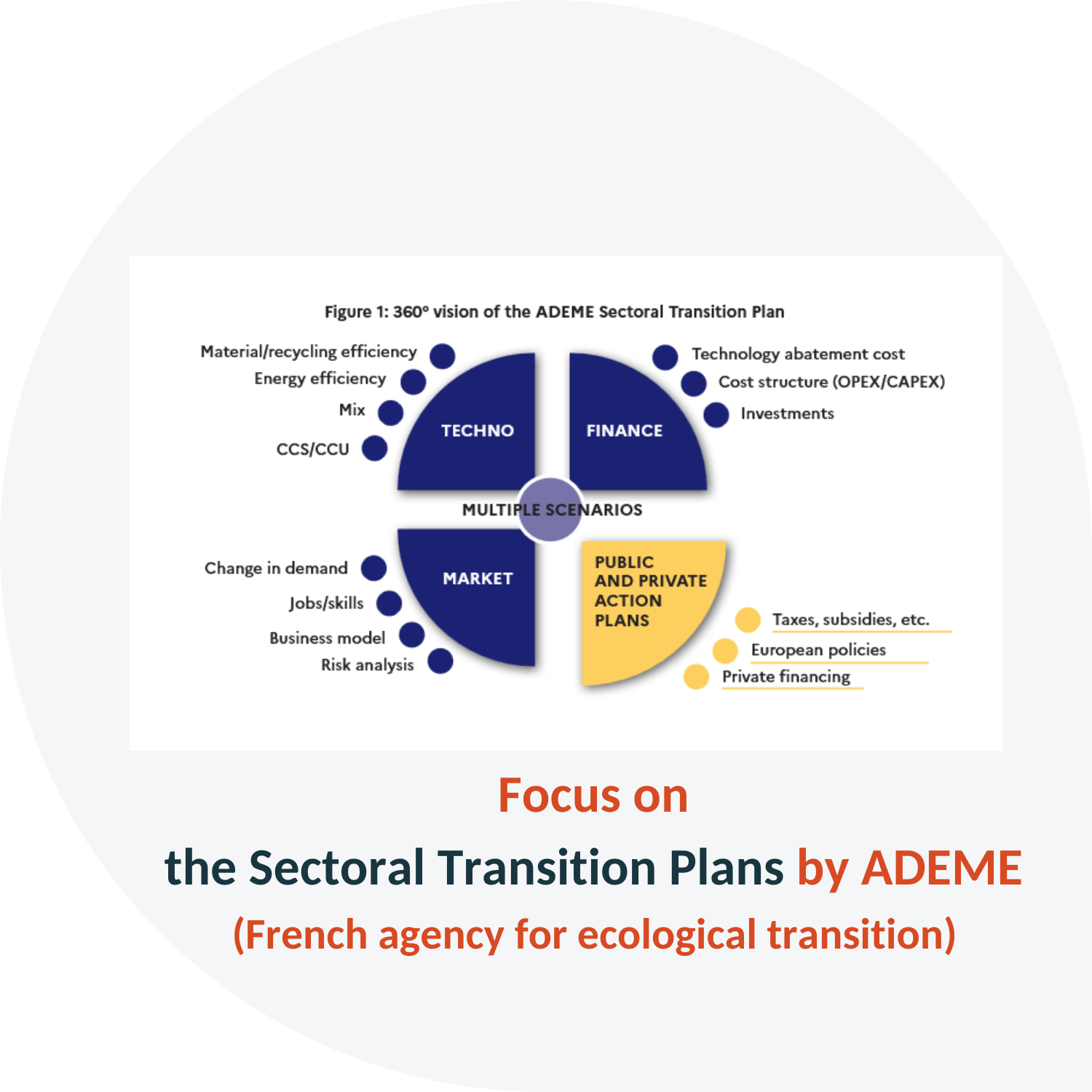
Find out more about the sectoral transition plans for a comprehensive overview of the challenges of the transition.
The French agency for ecological transition (ADEME) has developed a modelling suite and a set of Sectoral Transition Plans (“STP”) for the most energy-intensive sectors in France: cement, aluminium, steel, three chemicals (ammonia, ethylene and chlore), glass, sugar and pulp and paper. Each sectoral transition plan has been subject to a forward-looking study, as part of the LIFE programme. They involved a team of 30 full-time staff over a five-year period, in collaboration with eight trade associations and 225 partner industrial sites.
FOCUS ON Sectoral Transition Plan :
What are the benefits for each industrial sector?
- Identify possible and relevant decarbonisation pathways to reduce greenhouse gas emissions as much as possible in the medium and long term.
- Prioritise decarbonisation strategies and recognise potential obstacles to the decarbonisation of industry.
- Clarify on the investments required to decarbonise their operations.
- Analyse the potential effects of decarbonisation levers, which may vary depending on a more or less favourable context (e.g. regulatory framework, market trends, energy prices, etc.)
- Analyse the resilience of the industrial sector across a wide range of scenarios in order to anticipate risks and assist in the development of investment strategies for decarbonisation.
- Foster public-private dialogue on actions to enable these pathways, such as those relating to regulation, training, and the private and public funding to support decarbonisation.
- Put the various possible decarbonisation pathways into perspective with the carbon budgets of the French climate strategy.
Analysis and cross-cutting issues :
A review of the nine sectoral transition plans highlights common challenges and lessons learnt. This cross-cutting analysis sheds light on the technological, economic and employment dimensions, and helps to identify the key factors for accelerating the decarbonisation of energy-intensive industries.
Work in progress – not yet published